Today’s a busy day at work for me, but I still have had time to squeeze in a bit of adventuring! For my adventure today, I wondered if I might be able to work out how to create a video with a music trailer.
I created the music trailer image in Windows Movie Maker (I had to learn how to resize an image to make it a full-screen fit) and uploaded it to YouTube. Using YouTube’s video editor, I added music to the this video. I then recorded a second video and uploaded that to YouTube. Again, using the editing facility, I merged the 2 videos and held my breath to see whether the cross-fade function I’d selected for the image also worked with the sound files : turns out it does!
Whilst the result is a little rough and ready, I’m now looking forward to refining the technique 🙂
For today’s adventure, I’ve done a few things to support the success of The Big Renga Project!
I’ve built a website which you can check out here ~ the structure is complete, but the content will take a little time to finish. The project also has its own Facebook page which you can view here , and a private Facebook group to support the renju (the collaborative poets).
I might actually need a wee lie down after today’s adventure!
I’m sure you may have realised by now that I’m a bit of a haiku fan 🙂 . As part of the research for my book Seventeen Syllables ~ Cultivating Presence Through Poetry, I looked at the origins of the haiku form. What is now known as haiku was originally known as hokku, the first verse of a collaborative linked- verse poem called a renga.
The renga form has been around since the thirteenth century, and you can find out more about it here. In a nutshell, groups of poets works together to create a linked poem. The first stanza follows a 3-line 5-7-5 syllable format, just like the haiku. It also contains a kigo (season word) and a kireji (cutting word). The second stanza responds to the first stanza, but this time in a 2-line 7-7 syllable format. The renga then gets handed back to the first poet or handed on to the third who, again, works with what is offered in the second stanza but employs the structure of the first (7-5-7).
This sequence of 3-line and 2-line structures is then repeated until the poem is done!
I thought is would be fun to work with other poets to create a renga poem called “December” to capture the spirit of this month. As December will be the last month of my 365 Days Of Adventure project, it feels like collaborating with others might be a lovely way to end the year.
So, for today’s adventure, I’m launching The Big Renga Project and this is where you come in! I’m putting out a call for a crew of 23 poets to join me in creating a 25-verse renga. Whilst no previous poetry-writing experience is required to join the project, I’m looking for people who are
Up for learning about, and respecting, the renga form
Keen to collaborate and be part of a supportive, playful, creative community
Able to keep their commitments
Prepared to be responsive and present to the previous stanza
Respectful of the emergent spirit of the renga
Willing to record their stanza in video format (so I can create a film of the whole renga with all the poets involved)
The project will start on December the 1st and the final verse will be created on the 25th. I will create a private Facebook group to facilitate collaboration and information sharing. Each day during December, the poem will be updated so that people can see the renga grow.
If this sounds like this project could be for you, please drop me an email to jane@janetalbot.com in the first instance. If you know of others who might enjoy being part of this collaborative venture, please feel free to share this information with them.
NOTE – it is not necessary for the poetry to be written in English. However, to support other poets, a translation into English will be required for a smooth stanza transition! For all non-English stanzas, subtitles will be required for the video 🙂 .
Whilst my year of adventure is coming to an end, I am exquisitely aware of something new beginning in me. I’ve felt it for a while, and I’m not even sure I can put it into words yet, but it has something to do with my haiku adventure and something to do with trees and something to do with Japan.
As I’ve been doing research for my book, Seventeen Syllables : Cultivating Presence Through Poetry, I’ve become fascinated by the haiku form and its origins. The modern haiku form is most closely associated with the seventeenth century poet, Matsuo Bashō.
In 1686, Bashō composed one of his best-remembered haiku. Historians believe that this poem became instantly famous.
古池や蛙飛こむ水のおと furu ike ya / kawazu tobikomu / mizu no oto An ancient pond / a frog jumps in / the sound of water
For today’s adventure, I’m going to recite this haiku in Japanese. It’s not only considered to be the most famous haiku poem written by Bashō, it’s also considered to be one of the most famous haiku in the world! I learned how to recite the poem by watching this brilliant video on YouTube.
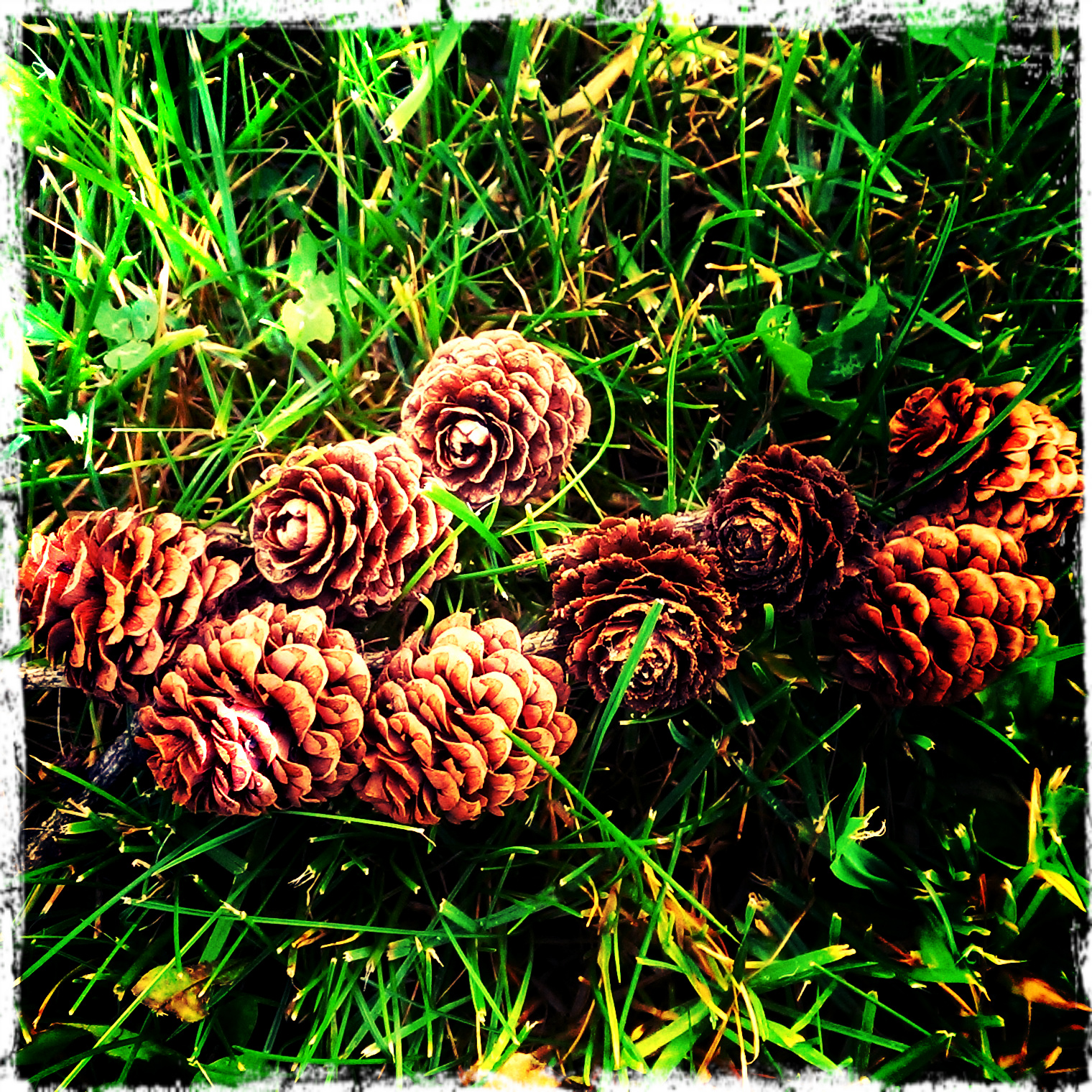
Last week, whilst walking my dog, I noticed lots of larch cones on the forest floor, some still attached to small twigs and branches. I picked a few up with the intention of learning more about larch seeds and of seeing whether I could grow a larch tree from seed.
I consulted a range of sources before beginning the process of attempting to harvest the seeds. I learned that the cones of larch may open and close according to climatic conditions, so whilst the cones may have “dropped” some of their seeds already, it might be possible that the cones I had picked up still held some seeds too.
All sources recommended that the cones be put into a warm room to encourage them to open. I put my cones into a paper bag in the bottom of our airing cupboard.
Today I opened the paper bag and started my larch seed adventure! I tapped and shook the cones gently to see what came out. I didn’t really know what to expect or how to recognise a larch seed. To my delight, some of the cones did yield some very small, light brown seeds with very delicate “wings”. I did a Google search for images of larch seeds, and I was excited to discover that I had indeed managed to harvest a modest number of seeds.
Some sources suggest that these seeds can be planted immediately. My trusted tree bible, Tree Planting And Aftercare , suggests that such seeds are better stored in a polythene bag in a fridge at 2-5 degrees celsius until sowing time (usually around the beginning of March).
Closer to sowing time, I can decide whether I sow straight into a seed tray or use a pre-sowing method like stratifying (as with elder). Should I want to optimise the germination rate, I could also consider “sowing” seeds directly onto a tray lined with moist kitchen paper. The tray would then be placed in a polythene bag and returned to the fridge for 3-6 weeks. After the chilling period, the tray is then brought to room temperature but kept covered with newspaper. The tray needs to be kept dark until the seeds germinate. When the seeds have germinated, they can be planted out!
After the refreshing impact of my ginko walk yesterday, I’ve decided to take a short break from writing. It didn’t take me long to discover today’s adventure – it was actually waiting for me when I woke up!
When I checked my emails this morning, I could see a note from my from my friend, Caroline. The note contained one thing : a link to details about BBC Radio 4’s Listener Week . During Listener Week, there is an opportunity for listeners to share their own stories. I smiled when I read that 🙂 .
So for today’s adventure, I wrote an email to BBC Radio 4’s Womans Hour expressing an interest in sharing my 365 Days Of Adventure story. It felt really exciting to press the “Send” button. Although the automatic email reply that I received made it quite clear that the chances of my story getting shared may be minimal, the most important thing for me is that I sent the email to them in the first place. This is me getting on the pitch 🙂 . Who knows what might happen? ….
Well, listen. I know I said I wouldn’t be back until the 20th, but I’m breaking “radio silence” now because the blog post on the 20th would be so long that I decided it might be better to give you an interim report before then.
I know I also said that I would edit all my video-blogs into one film, but if I did that, it would be a full feature-length film! So I’ve decided to post each vlog separately (with the exception of the 5th and 6th day which is edited into one film) in this post 🙂 .
So, here’s how it’s been going ….. (there are 5 videos in total 🙂 )
On Day 1, I learn how to create drop capitals in Word
On Day 2, I learn how to format a book for self-publishing
On Day 3, I get clear about the purpose of my book (and suffer a bout of “writers’ block”)
On Day 4, I learn all about the history of haiku poetry
On Day 5, I seem to be back in my flow … only to realise on Day 6 that I need to get some perspective (and so I take a ginko walk)
I know. I know. I know. What took me so long? Well, I have to admit that I’m pretty old-school when it comes to books : I love the smell of a real paper book, and I love the feel of turning the pages. I love opening and closing books : when they are opened, it feels like the contents come to life right in front of me ; when they are closed, it feels like I pressed the “pause” button and nothing can happen without me.
For me, a book is a living thing. When I read a book, I write over it. I talk to it. I listen to it. I have a relationship with it.
So, I never really got the appeal of Kindles – and I don’t own one. It turns out, however, that my laptop does have a Kindle app (I “tripped” over it a few months ago) but I never intended to use it. Until today!
Yesterday a book arrived in the post. It is brilliant. Totally brilliant. Unexpectedly brilliant. No-one recommended this book to me – it was another one of those stumbling things. I was looking for something to help me navigate the wilds of self-publishing, and I came across a book called The Easy Step-By-Step Guide For Self-Publishing Your Book In Print Using Create Space . When I dipped into the Create Space website to create an account, I made the terrible mistake of clicking on a few links. Those were deadly clicks leading me to all sorts of fora where people were getting het up about things I didn’t even know existed!
I have to admit that the whole process looked a little daunting, so I decided to reduce my fears by attempting to understand more about it. The book that arrived yesterday is spot on for what I need. It’s written in jargon-free language, the writer anticipates and answers questions ~ and he’s very reassuring. The book was so good that I decided to buy the Amazon Kindle Publishing Bookwritten by the same author, Jon Roetman.
And that’s where the Kindle adventure comes in : the book is only available in Kindle format. So, I did it! I bought a Kindle book 🙂 . It felt like magic when the book suddenly arrived on my laptop, but when I opened it I found it difficult to read. The words were where what I expected (and again, I’m super-pleased with my purchase) but my head doesn’t seem to like the format. I wonder if my brain will adapt to the Kindle format? (I’m definitely going to read it, so I’ll let you know how that plays out).
So, anyway – that’s me. I’m all set to complete my writing project. For the next week or so, I’m going to go to a writing retreat (in my own office 😛 ). I got so much out of my summer “Big Distraction Project“, that I’m taking a break from social media AND blogging in order to immerse myself in the author experience. I’ll still be recording daily video-blogs but I won’t post them until I come out of retreat. All the vlogs will be edited into one film and I’ll include that film in my next blog post which will be at the end of my retreat.
For today’s adventure, I’m nudging my haiku book project a little further towards completion. The brilliant news is that, in addition to my peer reviewers, I now have 4 people who have volunteered to try out the processes I describe in the book, Seventeen Syllables : Cultivating Presence Through Poetry (that’s the current working title).
Not only will these 4 people be able to give me feedback about the book and the processes, but I’ll also be able to measure the impact of working through the processes by taking a “before and after” measure. And that’s what today’s adventure has been all about : devising a questionnaire that will give me useful information about their motivations for joining the programme, that will give me clarity regarding their expectations about the programme, and that will let me know their starting point.
This feels very exciting. I know that the process had a profound, and positive, impact on me. Doing this upfront research with people who are genuinely attracted to the idea has the potential not only to provide me with a useful evidence base (and an important understanding of the range of impacts that might be experienced) but also with information that will help me to market my book in the right way.
In short, I’m setting about learning about my potential readership and how to communicate with them!
Okay. I admit it. I can’t actually help myself when an opportunity to haiku arises (I may just have made that verb up, but I like it 🙂 ). I was going to call my haiku collection complete at 30 (I was saving number 30 for the first frost) but today was too good an opportunity to miss, too rich an experience not to explore.
At 11.55 am BST today, the lunar eclipse was going to be at totality – there would be a second chance this year to see a blood moon. I watched the first total lunar eclipse in April, live-streamed from the Griffith Observatory in the US. It was a fantastic experience : I felt connected to the people at the observatory who were witnessing the celestial spectacle, and I felt connected to our small corner of the universe too. People were really enjoying their connection to the moon, shouting “Dragon be gone!” as they urged the orange-red dragon breath to disappear and give the moon back to Earth.
So, today the impulse to watch the live-stream of the second total lunar eclipse of the year took me by surprise. It wasn’t going to be a brand new experience, and I knew how total lunar eclipses worked, so I wondered if the experience might feel “less than” my first experience.
I tuned into the livestream from the Griffith Observatory about 20 minutes before totality. This time there were no crowds, just a few commentators. It wasn’t being celebrated in the same way, and yet I did experience the witnessing of this event as a much deeper, primitive, somatic celebration. I didn’t feel connected to the people in the same way, and yet I did feel connected to the human story in a very profound way. And this experience not only took me by surprise, it took my breath away.
During a total lunar eclipse, the Earth stands between the Moon and the Sun. The Earth covers the Sun – but not completely. If you were to look at the Earth during a total lunar eclipse, you would see a halo of fire around its entire circumference. The halo you would observe is every sunset and sunrise happening on Earth simultaneously!
As the Moon moves into the Earth’s shadow, the light from the Sun is “bent” around the Earth and causes a bloody, ferrous glow . The Moon becomes blood-red because it reflects this ferrous glow. The Moon is reflecting back to the observer all the sunrises and sunsets on Earth – all at once!
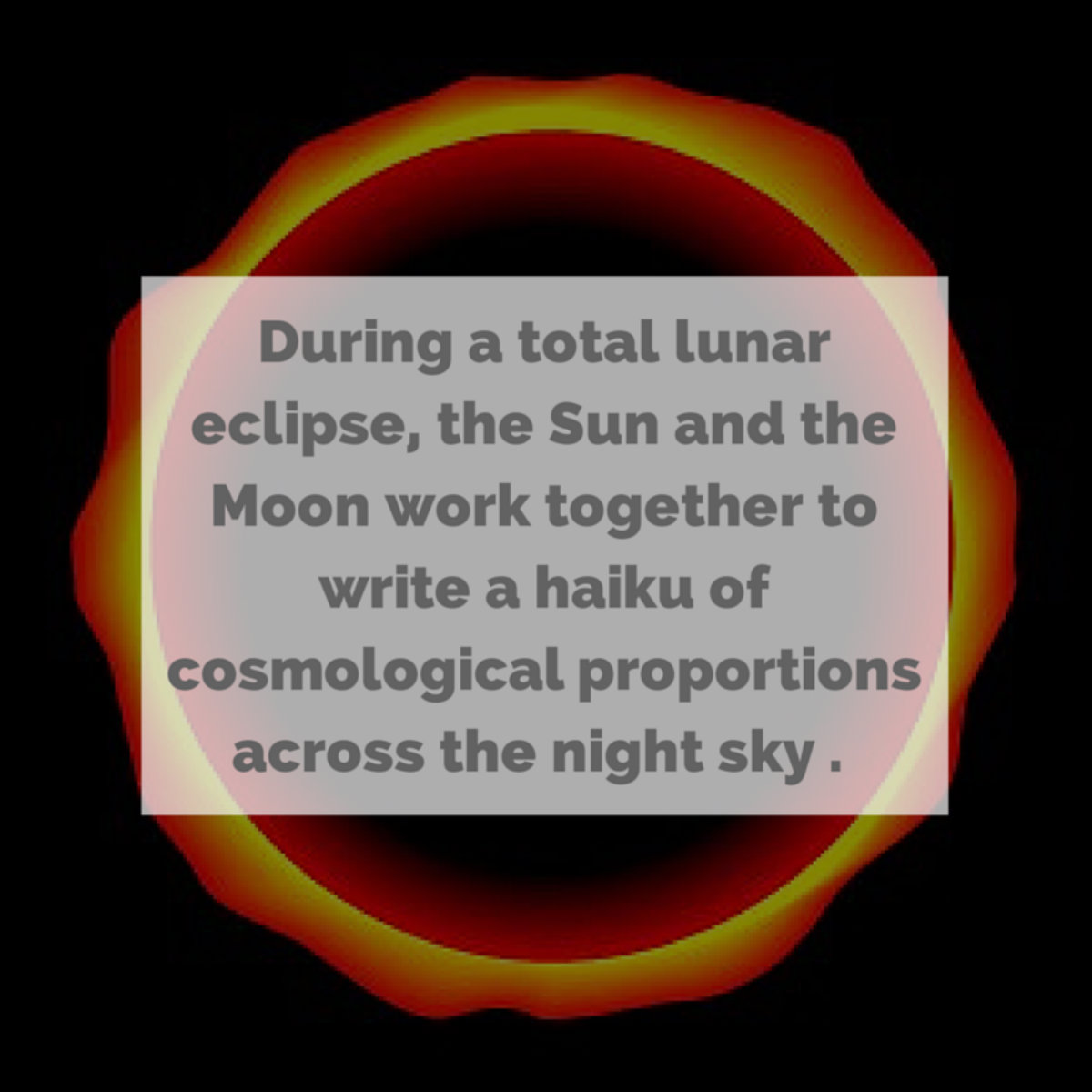
Now, when you stop for a moment and really consider what you’re witnessing … well, you could see how that might take your breath away, right? And when you stop and really consider the symbolism of simultaneous beginnings and endings, of births and deaths, of eternal and inevitable cycles … and when you stop and really consider that you are observing this happening on a planet-size scale … and that you are seeing everything all at once… you begin to realise that a total lunar eclipse eclipse is, in fact, a haiku in its own right. The Sun and the Moon work together to write a haiku of cosmological proportions across the night sky . During the totality of an eclipse, you get to witness the essence of existence … in its totality… all at once. To be more precise, you don’t just witness it, you feel it in your body in such a way that it causes you to reflect too… just like the Moon.
Today reminded me that every moment is new. Every experience (even repeated) offers something new. And for the first time, I understood (I mean I REALLY got) the value of the haiku. For me, beneath the words of today’s haiku sits “everything”… all at once… in one breath. And that bone-deep understanding doesn’t just take your breath away, it makes you cry.





 Humans Resourced